

After the science and action items of trying to conceive (take supplements, time sex juuuust right), the first months of pregnancy honestly felt…anticlimactic. There is, quite simply, nothing to do. You really just have to wait around, hope that the pregnancy sticks, and go about your daily life. It’s way too soon to start preparing for an actual baby, but it’s too late for any of your conception best practices.
 Source: Skyler Espinoza
I was very lucky in that I experienced few of the classic first trimester symptoms: some nausea and a little fatigue but no vomiting or anything truly debilitating. The great part of this was that it let me live my life pretty much as normal. The strange part was that this huge thing had happened to me, and no one could tell, not even me. The biggest change wasn’t physical, but rather was an onset of anxiety that has followed me throughout my entire pregnancy. This anxiety in the first trimester boils down to a worry that something you do (or don’t do), could harm a barely implanted group of cells, endangering their journey towards becoming a baby.
In a lot of ways, this anxiety felt like the same flavor of worry that followed me during my career in sports. As an athlete, I constantly worried about my body, wanting to keep it safe and healthy. Avoiding sickness and injury is one of the best ways to set yourself up for baseline success as an athlete. There’s not much you can do to perform better if your health isn’t where it should be. As someone who loves ticking all of the boxes, this led to years of carefully controlling my habits, behaviors and environments. Was I getting enough sleep? Eating enough or too much? What if I tripped going down the stairs, broke a leg and missed my race season? I probably shouldn’t go downhill skiing. I probably shouldn’t eat that. It’s too late to eat that much, I need to sleep. Can I take this cold medicine? Is it WADA and USADA compliant? I should check that protein powder, does it have the right batch number?
It’s a feeling that your body doesn’t quite belong to you: that the consequences of your actions aren’t yours alone to bear. As an athlete, an injury or a doping sanction doesn’t just affect you. These are not only setbacks against all of the time, care and effort you’ve invested into yourself and your career, but they also set back teammates, coaches, staff and family counting on you: counting on your body to do its job.
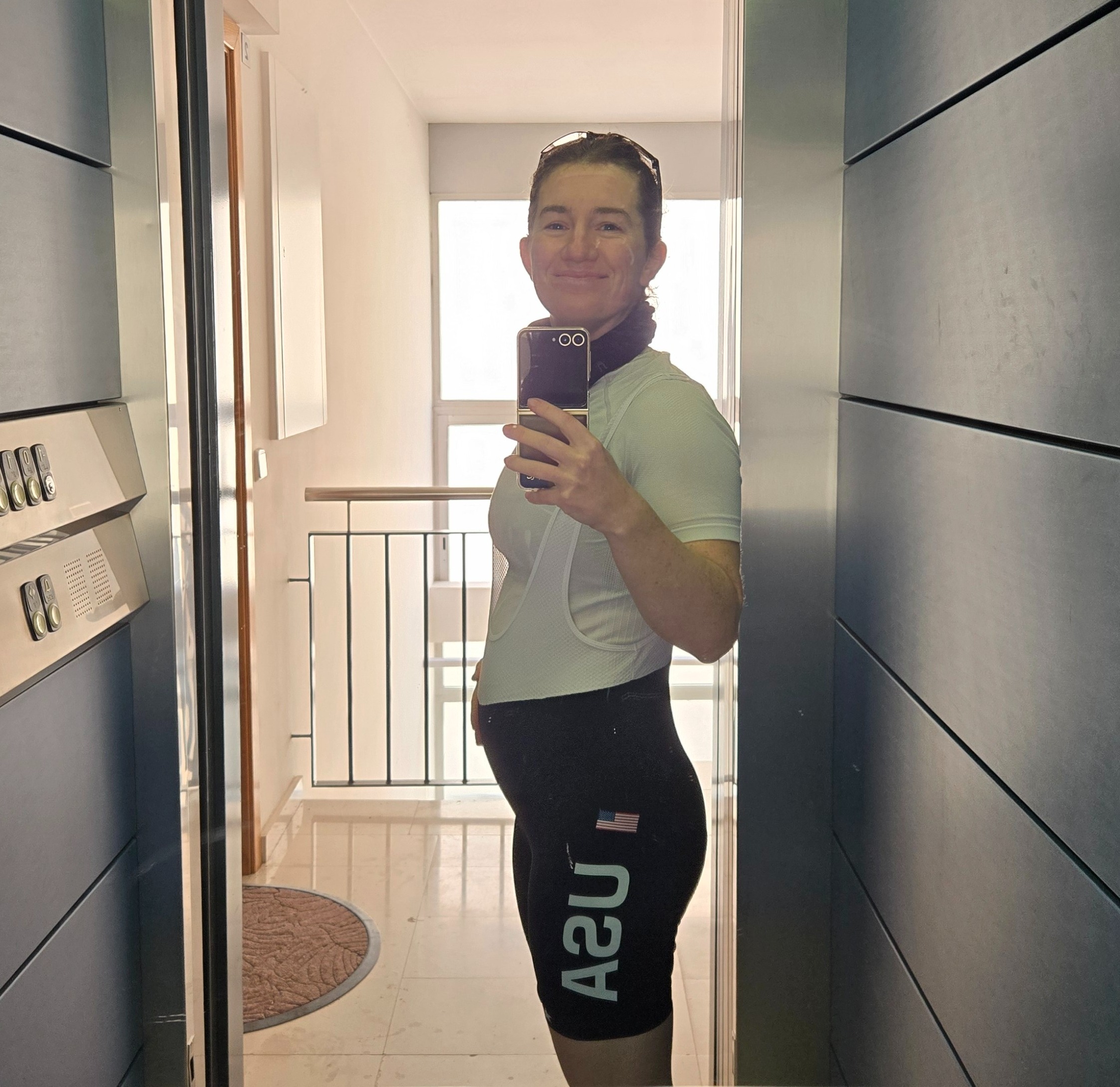
Pregnancy comes with its own list of rules, recommendations and regulations. There’s a list of medications you can and can’t take, foods you should and shouldn’t eat, activities you are encouraged to continue and things that you have to sacrifice for now. Perhaps the most infuriating thing about pregnancy recommendations is there are rarely reasons for why you should or shouldn’t do xyz. Outside of getting punched in the stomach, smoking, hard drugs and heavy drinking, the lines around acceptable behavior are hazy. It’s essentially impossible to do thorough, ethical research on pregnant women (you can’t tell one group of pregnant women to drink a lot and see what happens), so most of the recommendations we have to go off are best guesses or conclusions based on extrapolations. The bottom line ends up being, “it probably won’t hurt but best to avoid” for many behaviors, foods, environments.
 Source: Skyler Espinoza
The underlying anxiety of “my body doesn’t belong only to me” returned in full force and, with the ambiguity surrounding good decision making, it felt a little paralyzing. If “it probably won’t hurt… but it might!” is the official opinion regarding any choice, it’s easy to think that the best thing to do is say no to everything. Here are some of the action steps that I took during my first trimester that helped me through it and not feel absolutely insane:
1. Got off social media
As soon as you text a friend “I’m pregnant!” or, god forbid, download a pregnancy tracking app, it’s all over. You get targeted ads for pregnancy products on every screen you possess, and the social media algorithm feeds you uncannily specific videos. Whether I was 5.5 weeks pregnant or 12 weeks pregnant there was someone on Instagram exactly the same amount of pregnant as me, ready to tell me a horror story about her experience. No one wants to watch a video of someone saying, “wow I’ve had an extremely normal pregnancy so far and nothing is wrong! Stay tuned for a lack of updates!” However, we do get sucked in by, “I just lost my 5th pregnancy and my husband is leaving me for our fertile next door neighbor. Also I’m losing my house and my dog just died.” Deactivating my social media accounts helped me walk through life and my pregnancy at my pace and without the harbingers of doom scaring me about what might happen every time I opened my phone.
2. Found one source of information and stuck to it
It’s a cliché at this point, but googling pregnancy symptoms or questions is one of the most surefire ways to increase your anxiety. If you can, just don’t do it. Sometimes sources like Reddit can be helpful, but inevitably there will be information in these threads that will freak you out. Or, I guess, freaked me out (maybe you have the ability to read worst case scenario stories and know they don’t apply to you). I found Expecting Better by Emily Oster to be a great resource. She is a data scientist who puts an objective lens on a lot of the thorny pregnancy debates, and I really appreciated how she gives information, not recommendations. She recognizes that everyone is different, and will make different decisions based on the same data. I decided early on that that was the only pregnancy book I would read: all other questions I would save for my healthcare team. Is this limiting? Yes. But there is an unlimited amount of information out there about pregnancy, so honestly, putting limits somewhere is one of the only ways to keep your head above water.
3. Got support with my exercise
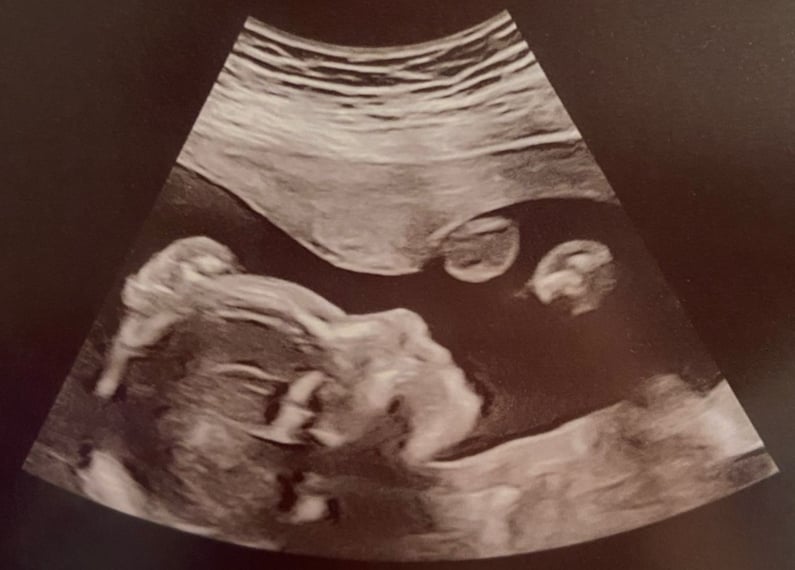
As a former professional athlete, what feels normal to me and my body in terms of exercise isn’t quite what most people have in mind. However, with the American College of Obstetricians and Gynecologists still recommending that pregnant women not lift more than 30 pounds, it’s easy to have exercise feel like yet another that needs to change drastically during pregnancy. Best stick to prenatal pilates and swimming, just to be on the safe side. I have been really lucky to have my strength programming written for me by a coach who has years of experience with pregnant athletes. Having a program has just taken the question marks out of my head: should I do this exercise? Is this one safe for my current stage of pregnancy? If you have access to someone with expertise and want to keep exercising or training at a high level, I definitely think it’s worth it. Even though I’m not training or competing at a high level any more, keeping movement as an integral part of my pregnancy has been a way to feel more like myself and connected to something familiar during a brand new experience. It’s something I recommend to everyone, even if you don’t identify as an athlete! If you’re looking for resources, Girls Gone Strong is a great one recommended to me by the US Olympic and Paralympic Training Center staff. They have free courses on pregnancy and postpartum, as well as sample exercise programs and much more. Super whether you’re a pregnant person, or a person in fitness looking to support anyone else who is pregnant!
 Source: Skyler Espinoza
The long and short of the first trimester, for me, is that it was a time to try to set up strategies that would serve me later on in my pregnancy. I think that, rather than focus on the baby (who really isn’t doing that much or needing that much at this point), try focusing on yourself and what you need to have a healthy and happy pregnancy. And please remember, in case this didn’t come across, what you need is not what anyone else on social media tells you you should need! It’s the beginning of a wild ride that is all your own.
This blog is part of An Athlete’s Pregnancy, a personal multi-part series chronicling one athlete’s experience navigating pregnancy after an elite sports career. Access part 2 here, or access part 4 here.
About Parity, a Group 1001 Company
Parity is a women’s sports consultancy focused on professional women athlete partnerships. With a mission to close the gender income gap in sports and beyond, Parity connects brands with a diverse network of more than 1,400 women’s sports athletes across 85+ sports, including 300+ Olympians and Paralympians. Through sponsorship activations, content collaborations, and strategic advisory, Parity helps brands authentically engage the most trusted voices in sports today. For more information, visit www.paritynow.co, or follow us on Instagram and LinkedIn.

.webp?width=600&name=USATSI_28449504%20(1).webp)
.webp?width=600&name=USATSI_17995740%20(1).webp)